Ring Watch: The Ultimate Guide
INTRODUCTION & HISTORY
The History of Ring Watches
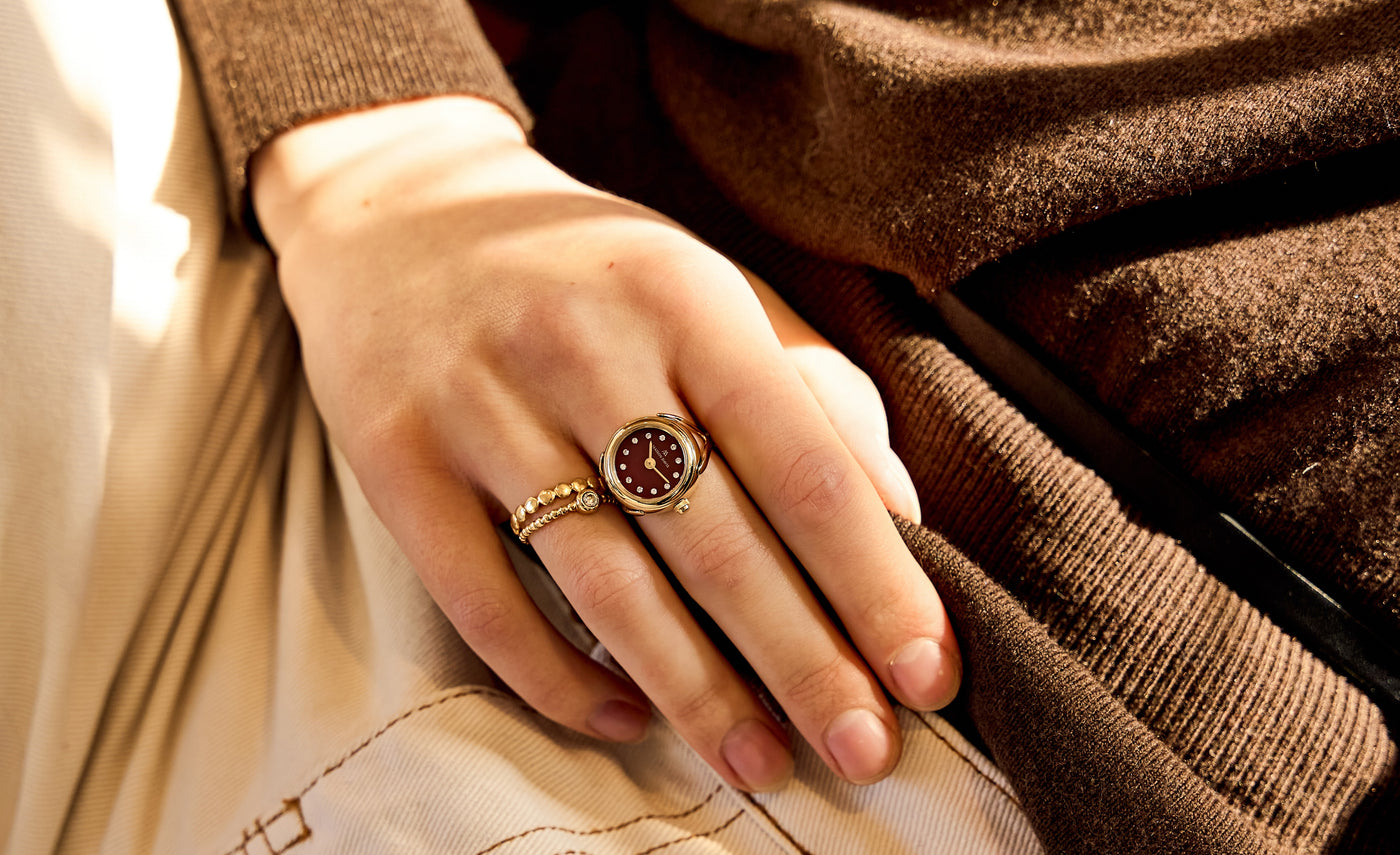
A ring watch is exactly what its name suggests: a fully functional timepiece designed to be worn on the finger like a ring. Combining watchmaking, jewellery and miniature engineering, ring watches occupy a particularly unusual place in the history of horology.
Long before smart rings and connected wearables appeared, watchmakers and jewellers were already experimenting with ways to reduce a complete timekeeping mechanism to a size small enough to be worn on the hand.
Over the centuries, ring watches have appeared in many forms: elaborate gold and enamel creations, diamond-set jewellery watches, miniature mechanical watches, playful quartz designs and, more recently, contemporary watches that reinterpret the concept using modern materials and movements.
Unlike a conventional wristwatch, a ring watch turns the act of reading the time into something far more discreet. The watch becomes part of the hand itself, somewhere between a piece of jewellery and a miniature horological instrument.
Today, the term ring watch can describe everything from a vintage mechanical watch mounted on a gold ring to a modern Swiss-made miniature watch with a sapphire crystal and gemstone dial. Despite their differences, they all originate from the same idea: putting a real watch on the finger.
What Is a Ring Watch?
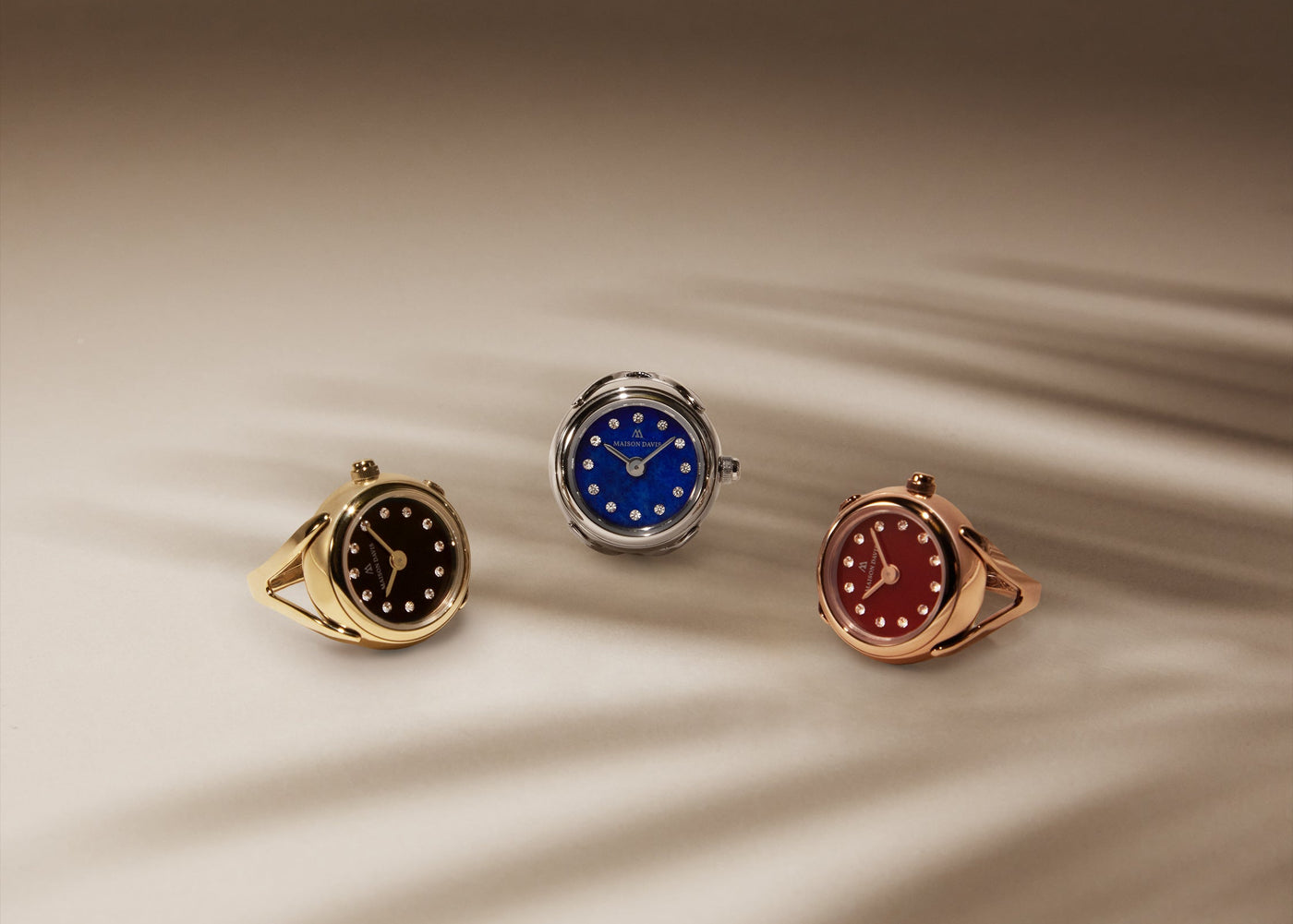
A ring watch is a miniature watch incorporated into a finger ring. Instead of attaching the watch case to a leather strap or metal bracelet, the case is mounted directly onto a ring-shaped structure designed to be worn around the finger.
The fundamental components are therefore surprisingly similar to those found in a traditional watch:
- a movement
- a dial
- hour and minute hands or a digital display
- a case
- a crystal
- a crown or another method of setting the time
The principal challenge is size.
Everything has to fit into a case small enough to remain comfortable on the hand. In a mechanical ring watch, this historically required extremely small movements and remarkable watchmaking skill. Modern quartz movements have made the architecture considerably more practical while allowing ring watches to become thinner, more accurate and easier to maintain.
This combination of miniature watchmaking and jewellery design is what differentiates a true ring watch from a decorative ring.
The origins of the Ring Watch
One of the earliest documented designs for a watch incorporated into a ring dates from 1561.
French goldsmith and engraver Pierre Woeiriot de Bouzey published a collection of jewellery designs in Lyon entitled Livre d'Aneaux d'Orfevrerie. Among the designs is an engraving showing a ring incorporating a raised watch case.
The engraving is now held by the Metropolitan Museum of Art in New York and provides fascinating evidence that the concept of a watch worn on the finger existed as early as the Renaissance.
At this time, portable watches themselves were still extraordinary objects. They were expensive, relatively imprecise and largely reserved for wealthy patrons.
Miniaturising such mechanisms further to incorporate them into jewellery was therefore both a technical challenge and a demonstration of craftsmanship.

Ring Watches in the 17th and 18th Centuries
During the following centuries, European watchmakers continued to experiment with increasingly small portable watches.
Ring watches remained rare objects. Making a movement small enough to sit comfortably on a finger was extremely difficult, and the resulting watches were often considerably larger than the rings we would consider wearable today.
Nevertheless, spectacular examples survive.
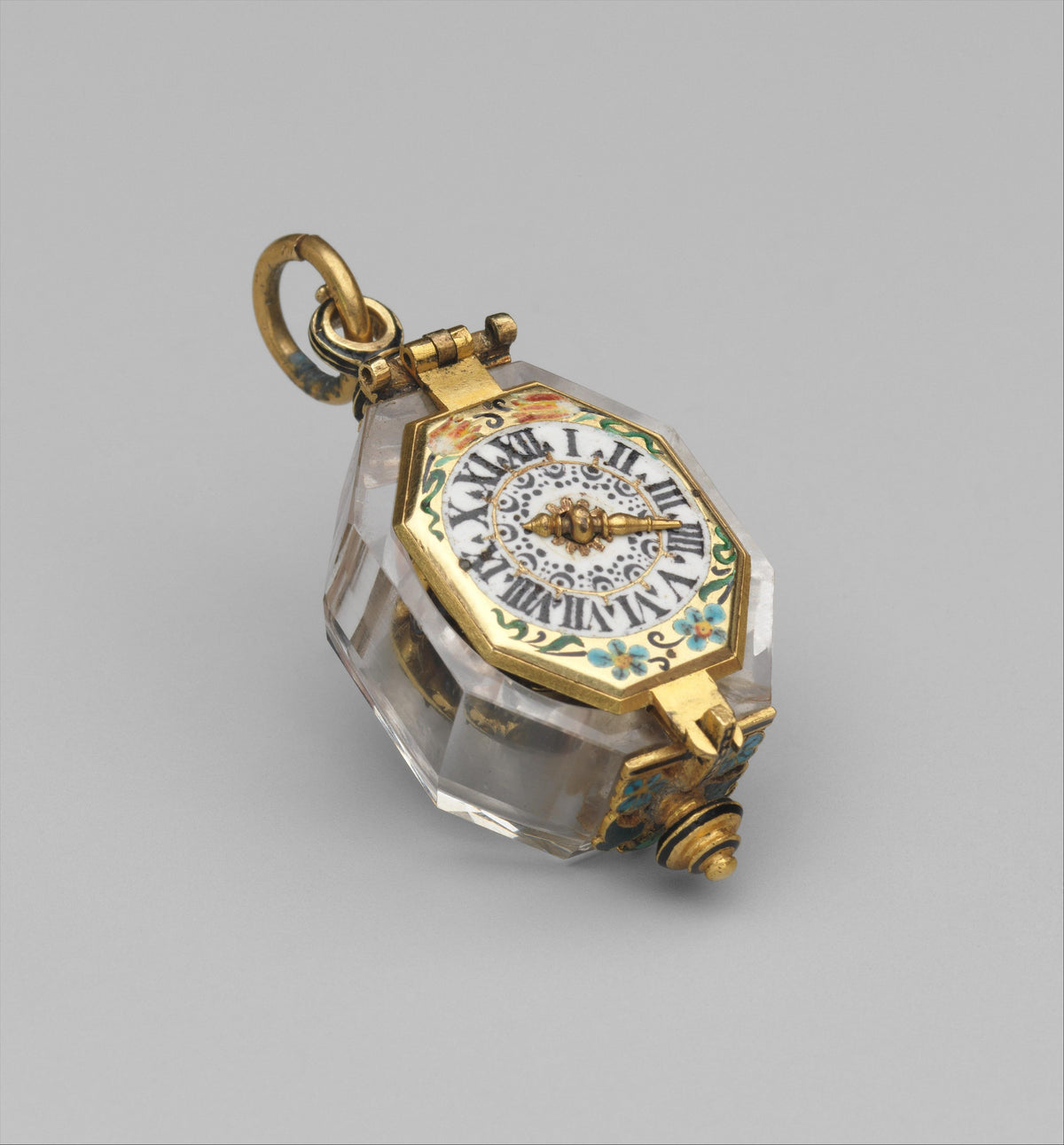
The British Museum, for example, holds a gold and enamel finger-ring watch made in Paris by the renowned watchmaker Jean-Antoine Lépine, dating from approximately 1769–1783. The piece incorporates a cylinder movement, enamel dial, date indication, pearls and decorative blue guilloché enamel.
It demonstrates something important about the evolution of the ring watch:
these objects were never simply about telling the time.
From their earliest days, they existed at the intersection of horology and jewellery.


The Ring Watch as a Piece of Jewellery
As watch movements became smaller, jewellers gained greater freedom to integrate them into elaborate designs.
Gold, enamel, pearls and precious stones could surround the dial, transforming the watch into an ornament whose timekeeping function was sometimes almost secondary.
Some ring watches concealed their dials beneath decorative covers. Others proudly displayed the watch face as the central element of the ring.
This dual identity remains one of the most interesting characteristics of the ring watch today.
A ring watch does not merely replace a wristwatch.
It belongs to another category altogether:
A functional piece of jewellery capable of telling the time.


Ring Watches in the 19th Century
The nineteenth century brought major improvements in watch manufacturing and miniaturisation.
According to the British Museum, finger-ring watches became particularly popular during the early nineteenth century as thinner movements gradually made the concept more practical.
Ring watches nevertheless remained unusual.
Pocket watches were far more convenient for everyday use, and later developments in wristwatches would eventually provide an even more practical way to read the time.
The ring watch therefore developed along a different path.
Instead of becoming the standard way to wear a watch, it increasingly became a creative speciality of watchmakers and jewellers.
That relative rarity is precisely what makes historical ring watches so fascinating today.
Art Deco and the Golden Age of Jewellery Watches
The Art Deco period of the 1920s and 1930s created ideal conditions for miniature jewellery watches.
Geometric forms, platinum, white gold and diamonds became central elements of jewellery design. At the same time, watchmakers were producing increasingly compact mechanical movements.
Ring watches could therefore become more elegant, refined and wearable.
Examples from the period often feature tiny rectangular, oval or round dials surrounded by diamonds and elaborate metalwork.
Rather than disguising the watch mechanism, these designs frequently celebrated the contrast between a miniature dial and precious jewellery.
From Mechanical Ring Watches to Quartz
During the twentieth century, wristwatches became the dominant form of personal timekeeping.
The ring watch never disappeared completely, however.
Smaller mechanical movements continued to make unusual finger watches possible, and examples from the 1950s, 1960s and 1970s can still be found among vintage watches today.
Some took a distinctly jewellery-oriented approach. Others became more playful and accessible.
For example, surviving ring watches from the 1960s and 1970s show how manufacturers adapted conventional miniature watch dials and mechanical movements to flexible or fixed ring structures.
The Quartz Revolution
The arrival of quartz technology changed the possibilities dramatically.
Quartz movements could be made small, reliable and accurate without requiring the complex architecture of a miniature mechanical calibre.
This opened the door to a new generation of ring watches during the late twentieth century.
Designers were no longer limited to extremely expensive miniature mechanical movements. Ring watches could become colourful, experimental and more accessible.

How Does a Ring Watch Work?
A ring watch works according to the same basic principles as a traditional wristwatch, but everything has to fit into a much smaller format.
Inside the case is a miniature watch movement that controls the hands and keeps track of time. The dial, hands, crystal, crown and case all perform essentially the same functions as they would on a wristwatch.
The main difference is the way the watch is worn.
Instead of being attached to a strap or bracelet around the wrist, the case is integrated into a ring that sits directly on the finger. This creates a unique engineering challenge: the watch must remain small and light enough to be comfortable, while still providing sufficient space for a reliable movement, readable dial and practical time-setting mechanism.
Modern ring watches generally use quartz movements because they combine excellent accuracy with extremely compact dimensions.
The Anatomy of a Ring Watch
Despite its miniature size, a modern ring watch contains many of the same components as a conventional watch.
The most important are:
Movement
The mechanism responsible for keeping time and moving the hands.
Dial
The visible face of the watch. Depending on the design, it can be made from metal, enamel, mother-of-pearl or natural stone.
Hands
Miniature hour and minute hands indicate the time.
Crystal
The transparent surface protecting the dial and hands.
Crown
A small external control used to set the time.
Case
The structure that protects the movement and holds the different components together.
Case back
The rear section of the watch case, which provides access to the movement for servicing or battery replacement.
Ring structure
The part that allows the watch itself to be worn around the finger.


The Movement Inside a Ring Watch
The movement is the heart of any watch.
Historically, ring watches could contain remarkably small mechanical movements. Producing such mechanisms required considerable watchmaking expertise, which explains why many early ring watches were rare and expensive objects.
Today, quartz technology makes miniature watches considerably more practical.
A quartz movement uses a battery to send an electrical current through a quartz crystal. The crystal oscillates at a highly stable frequency, allowing the movement to measure time accurately and control the motion of the hands.
Because quartz movements require fewer moving components than traditional mechanical movements, they can be particularly well suited to the limited space available inside a ring watch.
How Is the Time Set on a Ring Watch?
Most analogue ring watches use a miniature crown, just like a conventional wristwatch.
The crown is connected to the movement through a small stem.
When the crown is pulled into the time-setting position, rotating it moves the hands until the desired time is displayed. Once the time has been set, the crown is returned to its normal position.
Because a ring watch is significantly smaller than a wristwatch, its crown must be carefully designed. It needs to remain discreet enough not to interfere with comfort while still being accessible when the wearer wants to adjust the time.
For detailed instructions on setting the time, adjusting the ring size, battery replacement and care, see our complete Ring Watch User Manual.


How Are Ring Watches Powered?
Modern ring watches are usually powered by small watch batteries.
Because the hands and quartz movement require very little energy, these batteries can provide a long operating life despite their extremely small dimensions.
When the battery eventually runs out, it can normally be replaced by accessing the movement through the case back.
As with a conventional watch, battery replacement should preferably be carried out by a watchmaker or qualified jeweller, particularly when the case incorporates seals designed to provide water resistance.
What Is a Ring Watch Dial Made From?
The dial is one of the elements where ring watches can most clearly blur the boundary between watchmaking and jewellery.
Traditional watch dials can be produced from painted or lacquered metal, enamel, mother-of-pearl and many other decorative materials.
Natural stone offers another possibility.
Malachite, lapis lazuli, agate, aventurine and jasper can all create distinctive watch dials. Because natural stones have unique patterns and colour variations, no two stone dials are completely identical.
The small dimensions of a ring watch make these materials particularly striking. A relatively small surface becomes the visual centre of the entire piece.

Natural Stone Dials
At Maison Davis, we use natural stone dials to give each Ring Watch its own unique character. From malachite and lapis lazuli to white jade and red jasper, every stone reveals natural variations in colour, texture and pattern, making each dial subtly one of a kind.
What Protects the Dial?
Like any watch, a ring watch requires a transparent protective surface over the dial and hands.
Depending on the quality and construction of the watch, this may be mineral glass or sapphire crystal.
Sapphire crystal is particularly valued in watchmaking because of its excellent resistance to scratching. This can be especially useful for a watch worn on the hand, where accidental contact with surrounding objects is more likely than with a conventional wristwatch.
The crystal also contributes significantly to the appearance of the watch. Its shape, thickness and reflections influence how the dial is perceived.
Are Ring Watches Water Resistant?
Water resistance depends entirely on the construction of the individual ring watch.
A properly designed watch case may incorporate seals around areas where water could potentially enter, particularly the crown and case back.
Water resistance is generally expressed in atmospheres, commonly abbreviated as ATM, or in metres.
However, a water-resistance rating should never automatically be interpreted as permission to use every watch while swimming or diving. The manufacturer's recommendations should always be followed.
Seals can also deteriorate over time, and opening a watch for servicing or battery replacement may affect its water resistance if the watch is not correctly resealed.
Our Maison Davis Ring Watches, are water resistant to 5 ATM, a particularly challenging achievement at such a miniature scale. Creating an effective crown tube and sealing system within such a compact case requires extremely precise engineering, allowing the watch to retain its refined proportions while protecting the movement from water.
How Does a Ring Watch Fit the Finger?
Fit is particularly important for a ring watch.
While traditional rings are usually made in a specific size, some ring watches feature adjustable or flexible structures that allow them to accommodate different finger sizes.
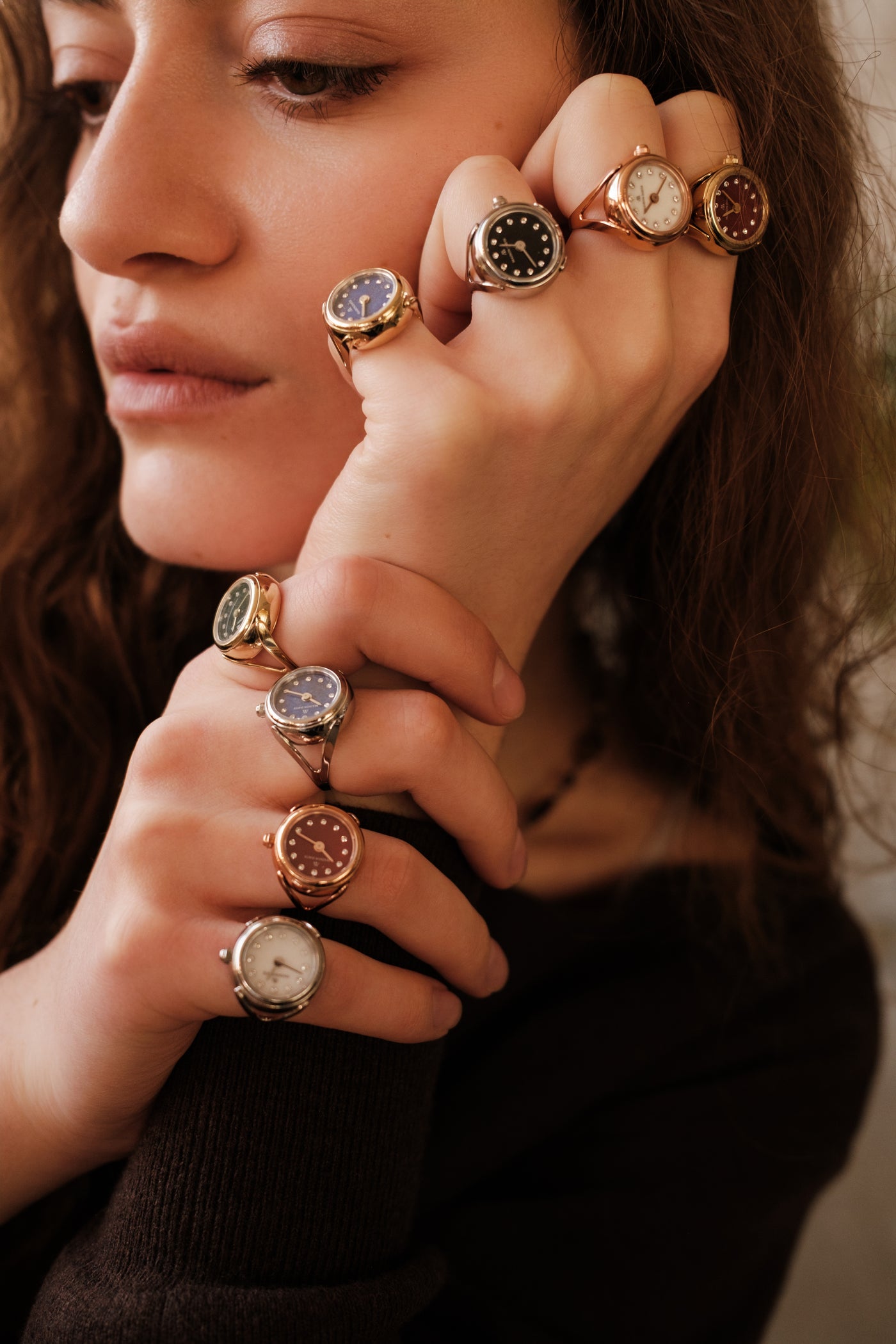
Maison Davis Ring Watches, feature an adjustable ring structure, allowing the fit to be adapted to different fingers and making it possible to change how the watch is worn.
A ring watch should fit securely enough to prevent excessive movement while remaining comfortable throughout the day. The size, weight and balance of the case also play an important role, helping the watch remain naturally positioned on top of the finger.
Is a Ring Watch a Watch or a Piece of Jewellery?
The answer is both.
Technically, a functional ring watch is a timepiece. It contains a movement and provides the same fundamental function as a wristwatch: displaying the time.
But the way it is worn changes its identity.
A ring occupies a much more jewellery-oriented position on the body than a wristwatch. Materials, proportions, gemstones, dial colours and metal finishes therefore play an unusually important role in the design.
This dual identity explains much of the enduring fascination surrounding ring watches.
They are not simply smaller wristwatches.
They represent a distinct category of wearable timepiece where watchmaking and jewellery meet on the finger.
From Davis to Maison Davis
A Ring Watch Story Since 1999
The Ring Watch has been part of the Davis story for more than 25 years.
In 1999, Pieter Davis designed the first Davis Ring Watch, creating his own interpretation of a centuries-old idea: a functional timepiece small enough to be worn on the finger. The design became a distinctive part of the Davis collection and continued to evolve over the years.
More than two decades later, in 2025, Julian Davis revisited his father's original concept with the ambition of bringing it into a new era of Swiss watchmaking.
The Ring Watch was completely reworked around a Swiss Made Ronda movement, sapphire crystal, 5 ATM water resistance and an adjustable ring structure. Natural stone dials including malachite, lapis lazuli, agate and jasper introduced a stronger connection between watchmaking and jewellery, while preserving the playful character of the original concept.
From Pieter Davis in 1999 to Julian Davis in 2025, the Ring Watch represents more than a product in the Maison Davis collection. It is a design passed from one generation to the next, continuously reinterpreted while remaining faithful to the same original idea: a real watch, worn as a ring.